Thick as a Brick
Fort Jefferson, Dr. Mudd, and a hundred and fifty years of suspended habeas corpus.
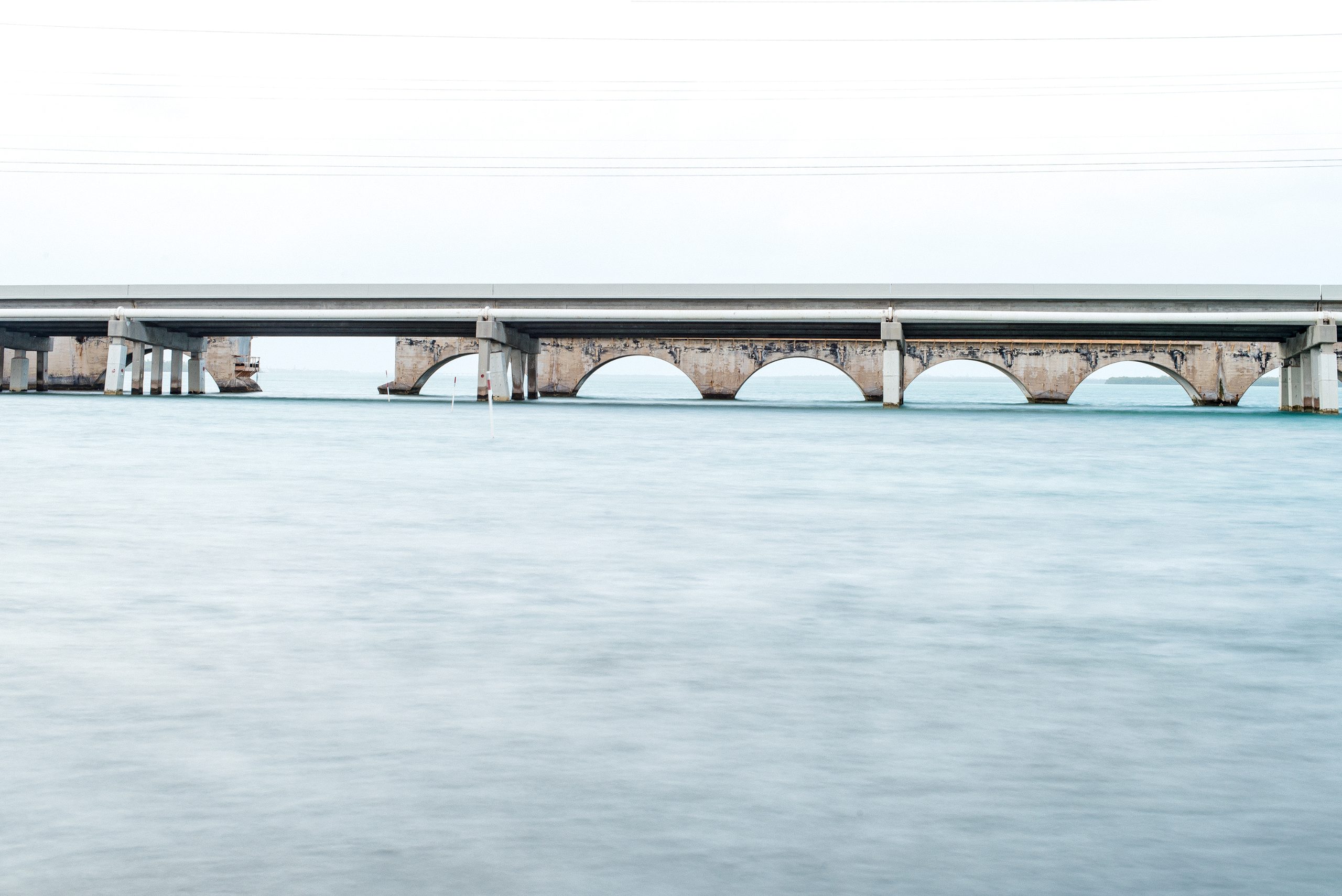
Driving through Miami and Homestead, there is a quick and imperceptible shift of the sands beneath our feet. A change between two distinct limestone formations occurs between the Miami Rock Ridge limestone formation and the Key Largo formation that dot the edge of the North American continent. The compositions each took 130,000 years alone to form, and provide a stable foundation to build on for the seven million people living there. Oxygen informs us of how this ground found its way under our feet. An individual atom of oxygen contains protons, neutrons, and electrons. A regular oxygen atom contains eight protons and eight neutrons; this is the most common isotope. However, other less common isotopes exist that contain either nine or ten neutrons. Mostly, there is the typical “light oxygen isotope,” and the less common “heavy oxygen isotope.” When climate scientists began taking core samples in specific locations, such as glaciers and sedimentary deposits, they began to see a relationship between the heavy and light oxygen isotopes.1 Since oxygen is the most common element on Earth, water is everywhere, and various factors lead to the water cycle, which circulates it continuously around the planet. Rain is in a constant process of transformation; frozen in glaciers, liquid in oceans, and evaporated in the clouds. Heavy oxygen condenses more easily than light oxygen, while light oxygen evaporates more easily than heavy oxygen. Deep ocean water and sediment samples, along with glacial ice samples, have fluctuating ratios of light and heavy oxygen trapped in them, giving climatologists insight into what the climate and ocean level looked like in any given period. During an ice age, water vapor containing light oxygen evaporates into the clouds and is locked away into vast glaciers, leaving the remaining ocean with a higher ratio of heavy oxygen. Conversely, as temperatures rise, the vast ice sheets melt, and freshwater pours into the ocean, increasing the sea levels and the concentrations of light oxygen water molecules.
Over 100 of these data sets have been collected, allowing us to accurately assess temperature and sea level as far back in time as six million years ago. With further analysis, maps could be projected back in time 15 million years. What does this data tell us precisely about this particular chunk of the earth? For one, it’s not very stable at all.
Samples taken from multiple locations around the world point to a different global climate 130,000 years ago. These samples show a greater abundance of light oxygen in ocean sediments. During this period, referred to as the Sangamon Interglacial, the earth had sea levels elevated 30-100 feet above those in the present day. Florida, at this time, was merely a series of fragmented archipelagos mostly submerged by a shallow sea. Ocean coal formed a calcium carbonate reef that took tens of thousands of years to construct, forming the basis of the vast limestone deposit that is the foundation for much of South Florida.
Transformation to what we see today started 11,000 years ago, with glaciers melting and discharging vast quantities of trapped water into the oceans, raising them approximately 300 feet in 3,000 years.2 Most of the limestone that formed became submerged underwater, except for the highest peaks underneath Miami, Naples, and the dotting of limestone peaks that form the Florida Keys. Those deer populations that had migrated there tens of thousands of years ago became trapped on the tiny islands, most notably on a tract of land, now set aside and known as the National Key Deer Refuge on Big Pine Key, and on some smaller and uninhabited keys. Proximity to humans dating back to Native American and European settlement saw their numbers fall to the point of near extinction. Because Key deers are not afraid of human interaction— they have the curiosity of a puppy dog—they frequent campsites regularly. Despite conservation efforts, their existing range has shrunk to a speck and this, combined with recent bacterial and parasitic infestations, leaves their future existence in doubt.3
In a blink of an eye—30,000 years or so—the Earth rapidly transformed, with ocean water evaporating and condensing in growing polar glaciers. This period, known as the Wisconsin Glaciation Event, saw sea levels fall dramatically, 300 feet below current sea levels, allowing for the exposure of land bridges across numerous locations. These conditions dried up the shallow seas that submerged Florida, leaving a vast landmass extending all the way to the continental shelf. These circumstances left exposed coral deposits to fossilize in time to the air, forming limestone, as well as revealed a fresh, new landmass for plant and animal life to migrate to. Species of animal, like the Florida Key deer, are believed to have made their way onto this landmass, living there for nearly 100,000 years.
Depending on ocean currents, sand would either build a key more massive, or the forces of erosion would sink a key back below the surface for years at a time. Seventy-five miles across this dredged shipping lane, on the confluence of Garden, Bush, and Long Keys, lies a vast sandcastle monument, Fort Jefferson at Dry Tortugas National Park. Looking like a sandcastle from an organized, decades-long beach holiday, using as its material the sand that the oceans deposited on its shoreline, the monument waits to be eroded back into the sea.
The four-hour drive across the Keys is one that could have been either an ocean voyage or a long hike across a craggy and flaky garden at two distinct periods of time in the past. On this occasion, we were traveling with the motion of a tossed stone, skipping across the newly formed waterfront along a string of bridges. Approximately 40 miles west is the terminus of US Route 1 at Key West; farther western keys are only accessible by boat or seaplane. Hopping on a boat, we passed by these Keys: Mule, Big and Little Mullet, Woman, and Ballast. Many were merely a sandbar just sticking out above the water.
The Third System of Coastal Defense
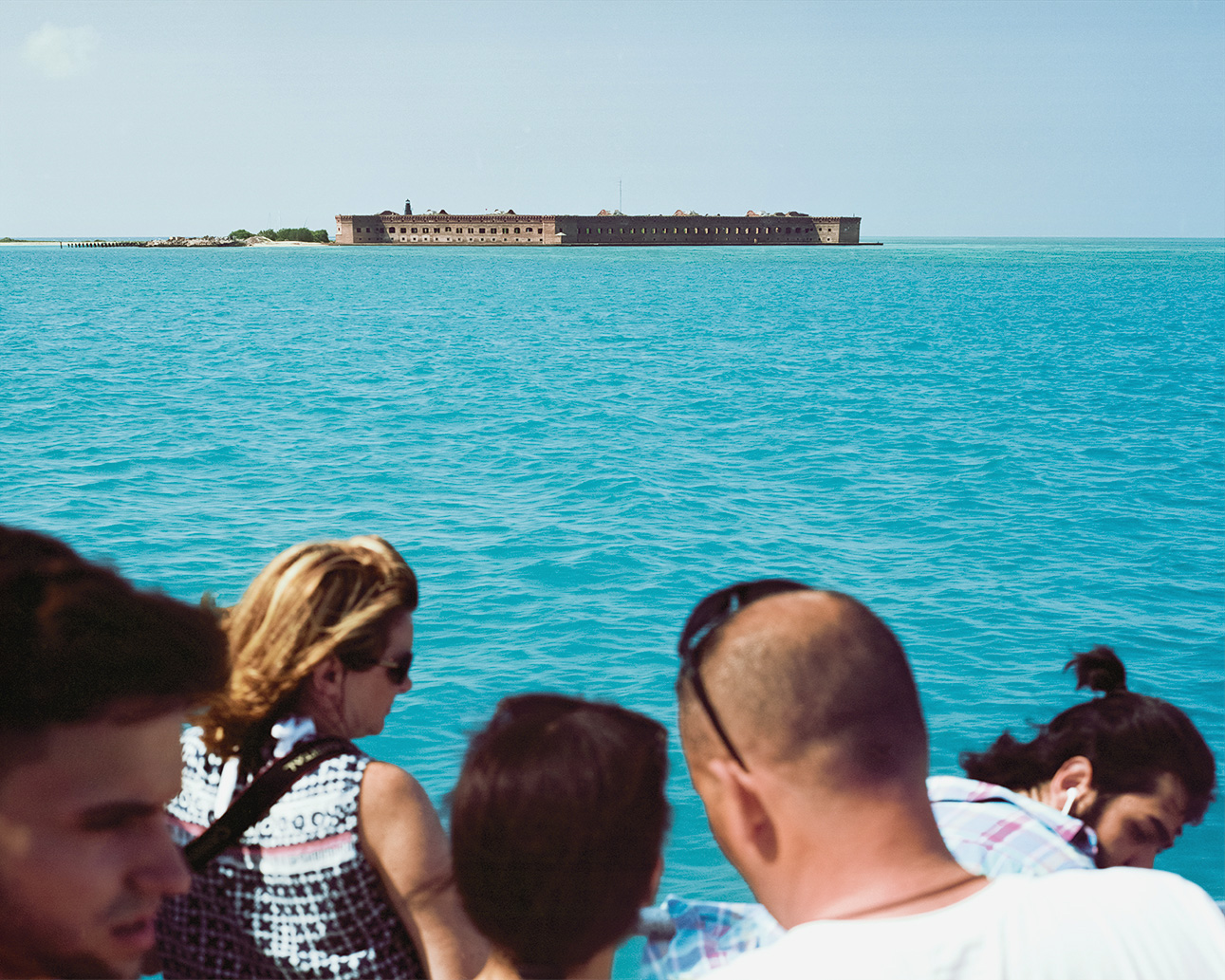
The last time the United States was invaded on a large scale was during the War of 1812, around the time of Fort Jefferson’s construction. Great Britain, wanting to reconquer the colonies it had lost, sent close to 50,000 soldiers to land on the northeastern Atlantic Seaboard. Simultaneously, they conducted a naval blockade that constricted American trade to Europe, nearly bankrupting the United States. After this conflict, the big word in military thinking was constructing a defense shield that would deter foreign naval forces from conducting any future naval blockades and defending the shoreline from naval bombardment and amphibious attack. Termed the “Third System of Coastal Defense,” it constituted a massive expanse of engineered fortified structures that acted as a defense shield across the eastern United States. It continued to be an extensive budgetary drain until after World War II.
From 1820 through the 1830s, the project was slowed by the debate surrounding the structural and financial challenges required to build the fortification. The 1830s saw opportunities of American expansionism, with Texas declaring its independence and then winning it through revolution. However, efforts to secure the Republic through annexation were frustrated with political gridlock regarding slavery, as well as the debts Texas had incurred in their war with Mexico. A geopolitical game formed between the United States, the Republic of Texas, Mexico, Britain, and France; negotiations lasted for much of the 1830s.
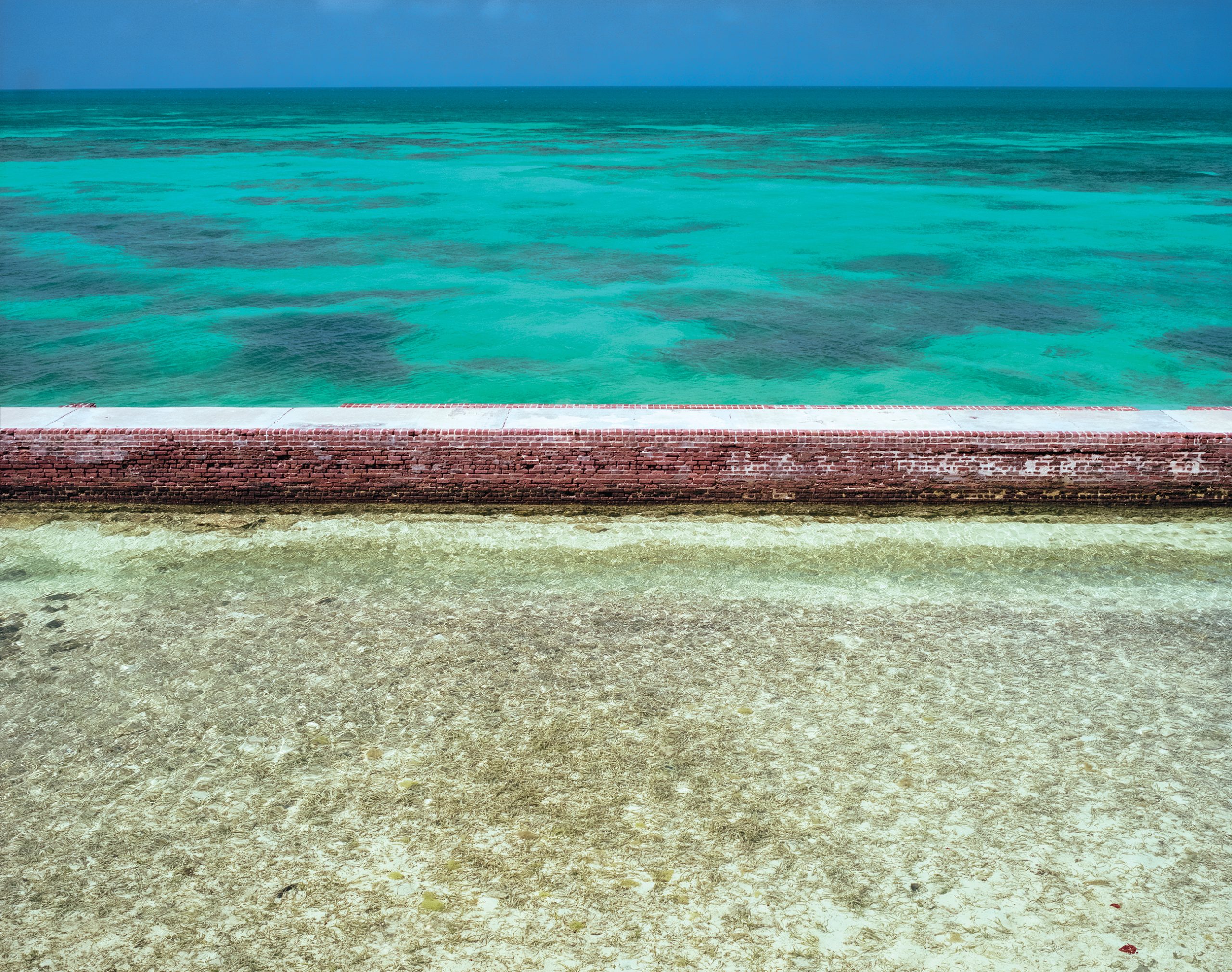
The 42 fortifications formed a shield along the East Coast of the United States, “leaving a trail of cost overruns and contented contractors.”4 Fort Jefferson was one of the more ambitious and costly examples of the nineteenth century defense project. In 1819, the United States purchased the Florida territory from the Spanish in the Adams-Onis Treaty. Garden Key was chosen as an excellent construction site in 1821, due to its proximity to shipping lanes that linked the ports along the Gulf of Mexico, the Mississippi River, and the Eastern Seaboard. In the 1820s, the prospect of military projection was evident in many arguments for constructing the fort. Commodore John Rodgers said of the project: “The commerce of la Habana and even the homeward bound trade of Jamaica would be subjected to its grasp.”5 Congress, intrigued with the potentiality of defensive and offensive power projection, approved the first phase of construction in their budget in 1822. A lighthouse was constructed on Garden Key and plans for the massive fort began to take shape.
The politics surrounding the funding of Fort Jefferson were embedded in the geopolitics of the Gulf of Mexico. Cuba, only 90 miles from the Dry Tortugas, had many Southerners worried about the prospects of decolonization. Many feared that Spain would, “see the Pearl of the Antilles slip from her grasp. If this occurred, the island, provided it did not fall into the hands of the British, might become another Haiti.”6 It was this initial fear that sparked approval of the construction funding for the project. On January 11, 1844, the United States Senate approved a budget appropriation of $50,000 (equivalent to $1.5 million in 2018) to start construction of fortifications on the remote key, so that it could position itself in proximity to support its new land acquisitions through the 1845 annexation of Texas. In the coming years, there would be struggles to maintain appropriations levels. Proponents of the project would sell the continuation of the project on fears of decolonized land masses inciting slave rebellions within the southern slave states. These arguments eventually led to the release of funds to continue work and production of materials.
Built on Sand
Fort Jefferson was planned as an elongated hexagon, distorted to efficiently encompass the entirety of the sandy island on which it was to sit. Four of the walls measured 476 feet, and two measured 325 feet. The fort was to be surrounded by a 70-foot moat and counterscarp with a perimeter of a mile. This moat served as the fort’s sewage system, with the garrison throwing filled latrines from the fortification into the moat with the hope that incoming seawater would flush it clean. This plan did not work as well as hoped, as the counterscarp blocked much of the water flow. The fort was planned to rise 50 feet above the key and be supported with more than 2,000 totten style arches. The building would be raw, only using concrete masonry, with limited stone accents.
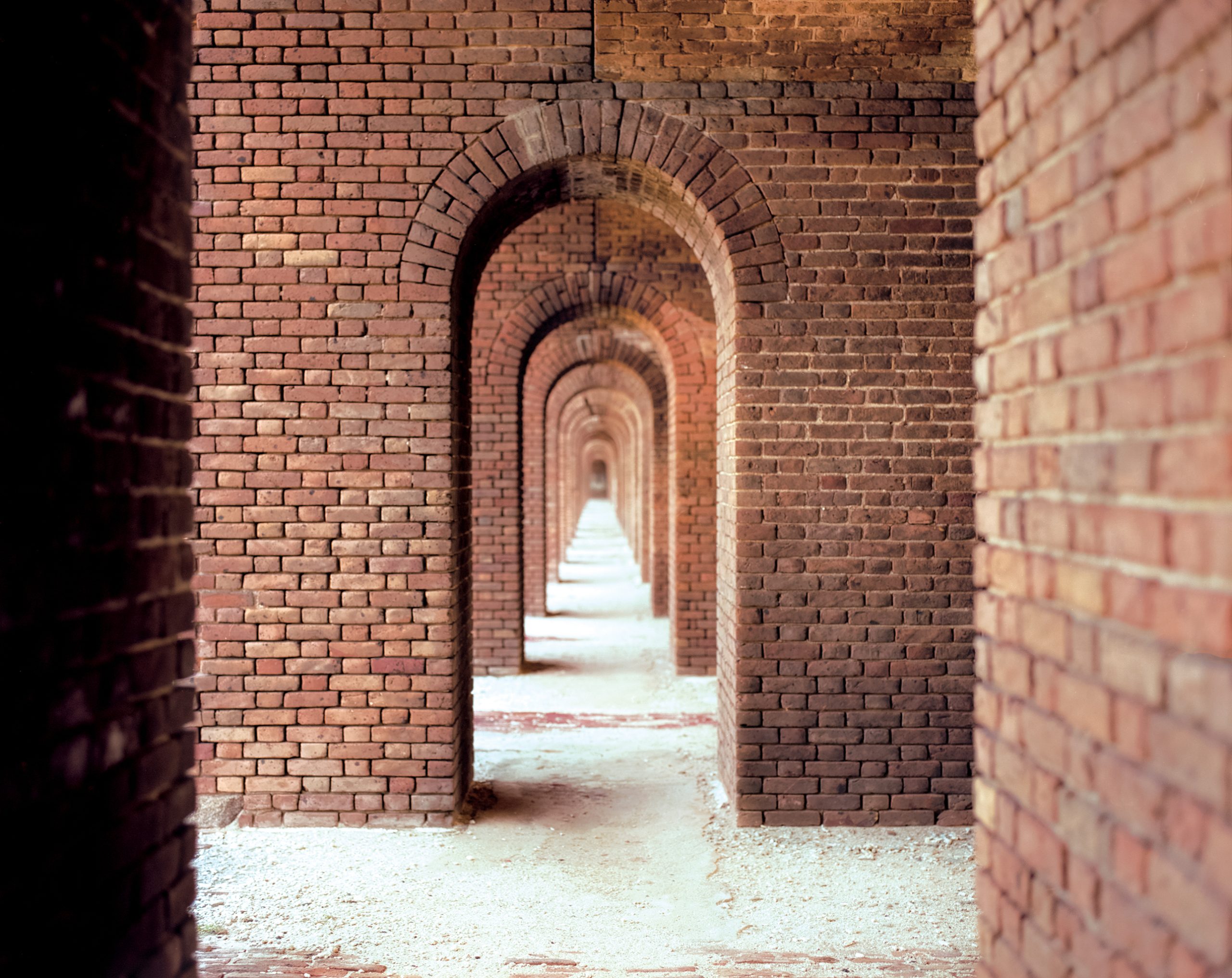
Planning commenced in 1847 when Horatio Wright of the Army Corps of Engineers stepped onto Garden Key. It was to be a momentous undertaking for the Army Corps, with a foundation fourteen feet wide, two feet thick, and a mile in circumference. Its structure was immense, in order to accommodate the vast amount of firepower to be embedded in the fortress, which had been planned to house more than 400 artillery guns and a garrison of 1,500 men. A workforce would be stationed on the remote key during the construction of the fort, comprised of skilled and unskilled labor recruited from the Keys and the peninsula.
Fort Jefferson was to be the first construction project for the Army Corps that utilized submarine concrete in the construction of its sunk piers and subterranean water cisterns. The plan was to contain 109 water cisterns that collected rainwater, as well as saltwater stills that boiled sea water to make freshwater. The above ground cisterns regularly degraded and leaked, due to the hot corrosive conditions of the Keys. The underground reservoirs would also prove useless in time, due to the sheer weight of the project. In the 1850s, as the project began lifting off the ground, evidence of subsidence became a topic of debate with the chief engineers. Engineer Joseph Totten was disturbed by the slight subsidence observed in certain walls in the area of the officers quarters. He concluded it to be a problem caused by the use of fresh coral and shell as embankment and concrete aggregate, saying “that they must ascertain whether coral when recently embanked would submit to compression under such heavyweights.” He had an experiment conducted to test this theory. A 12-foot square table was constructed of heavy planks, resting on four short posts and supported by a plank platform base. Lieutenant Horatio Wright stacked bricks six feet high across the entire surface of the tabletop, to exert a pressure on the ground equal to the scarp on which the officers quarters were located.
From the experiments, the engineers concluded that the ground that lay under Fort Jefferson varied significantly, with limestone bedrock as close as three feet below the surface to as deep as 50 feet in other areas. Some areas of the island were absent of any bedrock and were merely sand. Because of this irregularity, they concluded that as the height of the masonry walls rose above the site, compression forces would cause the wall to subside unpredictably, and to varying degrees, along the outer wall. The extreme subsidence eventually cracked the subterranean cistern, flooding it with saltwater.
A few months later, when subsidence slightly exceeded three-eighths of an inch, Wright noted the current pressure was being exerted on the scarp and loaded the table to a pressure of 33 cubic feet per square foot, with the table eventually subsiding an additional sixteenth of an inch. By December, the table had not subsided any further. During this period, the bank under the table had eroded substantially, having been subjected to heavy rains and storm tides. The table was moved near one of the bastions on the wall perimeter. After a few months at the new location, the table had subsided much more substantially; each leg had subsided two to four inches. They then increased the weight on the legs and left it for ten days. Upon returning, they found it had subsided even more dramatically, and that subsidence fluctuated considerably between the table legs.
Subsidence was brushed aside for a few years, but by 1863, cracks began to form on the exterior scarp wall near one of the bastions that were visible to boats approaching the fort. Breaks also began happening on the interior casemate arches supporting the wall. As rain began to fall and filter through the porous brick and mortar, the efflorescence of minerals like sodium carbonate started to make stalactites in the areas of the cracks, opening the walls up further to the forces of subsidence. Engineers began looking at the past data to track the subsidence of the structure over time. By September 1863, a record of settlement had been created to monitor the level of subsidence along the six bastions that encircled the fort: Bastion A had settled 1.468 feet Bastion B had settled 0.469 feet Bastion C had settled 1.523. feet Bastion D had settled 1.492 feet Bastion E had settled 0.539 feet Bastion F had settled 0.721 feet In some instances, there was a material difference between the levels of the parade and scarp walls, with the different weights resulting in the uneven casemate and flagstone floors. The fortification reached its full height in 1863, and was partially outfitted with a limited armament to aid in its defense from a Confederate attack. It never received anything approaching the 400 guns it was planned to have had, and never in its history fired its guns on anyone.
In 1861, Captain Robert Parker Parrott patented the Parrott Gun, which fired a 300-pound rifled projectile with such force it reduced once impregnable third system fortifications to grains of sand. On April 10, 1862, the new rifled artillery
Over time, the use of Fort Jefferson changed; what was meant to be a staging point for naval superiority and Union blockades was transformed into a prisoner of war camp. 1865 marked the climax of the dramatic history of Fort Jefferson. No longer a high profile engineering project, fewer than 15 engineers still worked on the project at this time. By the mid-1860s, Fort Jefferson’s obsolescence was made imminent due to advances in military technology. “Built like an aircraft carrier essentially to defend itself,”7 Fort Jefferson was a bulky line item on military spending budgets for three decades, and within two years, advances in rifled artillery guns made the spending exceedingly worthless.
pieces were used in the siege of Fort Pulaski, knocking down its eight feet thick walls in nine hours of constant bombardment from ships positioned five miles offshore. Fort Jefferson transitioned from a military fortification to a remote prisoner of war camp. The number of high profile political prisoners and their subsequent court cases gave the public an image of the prison comparable with that of the French prison Devil’s Island in French Guiana. The most notable of these prisoners was Dr. Samuel A. Mudd. To say someone’s name is “mud” does not originate with the disgraced doctor. Instead, the term had been in use before his infamy, originating in English slang to describe a person as stupid or twaddling. Samuel Mudd did not invent the name, but the profile of his disgrace as the man who helped thespian assassin John Wilkes Booth murder President Abraham Lincoln led him to be the term’s personifier. It is a story of numerous twists and turns, omissions and halftruths, extending well past the lives of those involved, and projecting into our beliefs, politics, and legal issues of the present. It is a story of a chain of events at the conclusion of the American Civil War that lay a foundation of legal precedents—precedents that have helped define our legal rights. It is not my aim to rehash the events that led to the assassination of the 16th president of the United States. There is already an existing cottage industry of writers and publishers who have spun narratives using the inexhaustible trove of public documents that outline the event.
Ex parte Merryman
When the Civil War first broke out in 1861, President Lincoln ordered the states to create militias to suppress the growing rebellion. Federal troops traveling from Washington to Baltimore encountered hostile mobs that would not let the soldiers pass into Confederate territory. The state of Maryland, though a slaveholding state, voted to not secede from the Union and was under Federal control. However, they voted to keep the railways closed to Union troop traffic and asked the federal government to remove their armies from the state. Despite pleadings from the state of Maryland,
This particular story originates in the event’s aftermath and the years of political warfare and public relations, of which the decaying Fort Jefferson was merely a backdrop. In the Civil War, the area surrounding the two capitals was a clandestine warzone, with secret agents, spies, and assassins hiding in plain sight. Government dissent was volatile and stood to discredit and potentially collapse the operation of the Union. The court system, which had not previously been subject to this level of chaos, quickly became a theatre of combat. Over the 150 years since then, it has relied upon the executive authority to maintain exploitable legal shortcomings.
Lincoln refused, and persisted with his order of troop movement through the state. In April of 1861, the president made an executive order to General Winfield Scott, the Commanding General of the Union Army, that if there was an event of resistance on the military line—from Annapolis to Washington—the Commanding Officer was authorized by the Commander in Chief to suspend habeas corpus if necessary.8 Legal recourse in civil law, habeas corpus, with its literal translation from Latin being “that you have the body,” is a formal court demand to produce the body of the accused to stand in front of a judge, to determine the legality of the detention of accused individuals. The writ of habeas corpus is referred to by English Judge William Blackstone in a 1768 commentary as “the great and efficacious writ in all manner of legal confinement.”9 Habeas corpus is a legal mechanism that instills a situational element to the system of due process, giving time to allow the correct decision to be made. Shortly after Lincoln’s executive order, the Maryland state legislature declared the state off limits for Union troop passage. Governor Thomas Hicks ordered the state militia to demolish multiple state-owned railroad bridges, leading to a militia lieutenant, John Merryman, to be arrested by order of a commanding officer.
While he was being held in military detention, Merryman’s lawyers went to Washington D.C. and asked Chief Supreme Court Justice Roger Taney to issue a writ of habeas corpus. Taney promptly wrote to Commander George Cadwalader, governor of Fort McHenry, the military prison in which Merryman was being held. Taney’s order was to produce Merryman to the circuit court in Baltimore. Cadwalader responded to the writ by sending a colonel to explain that the army had suspended the writ of habeas corpus under a presidential order. Cadwalader also proved a letter explaining the nature of Merryman’s crimes, including that he was arrested for treason, being in U.S. military weaponry, and aiding in armed hostility against the federal government.10 The message concluded, asking for an extension to reply to the issued writ so that he could get further instructions from President Lincoln. Justice Taney was not amused, and refused the request. Instead, he held Cadwalader in contempt of court for refusing the writ to produce John Merryman.
In his view, Tanney wrote: “These great and fundamental laws, which Congress itself could not suspend, have been disregarded and suspended, like the writ of habeas corpus, by a military order, supported by force of arms. Such is the case now before me, and I can only say that if the authority which the Constitution has confided to the judiciary department and judicial officers, may thus, upon any pretext or under any circumstances, be usurped by the military power, at its discretion, the people of the United States are no longer living under a government of laws, but every citizen holds life, liberty, and property at the will and pleasure of the army officer in whose military district he may happen to be found.”11
Justice Taney then issued a writ of attachment, ordering a United States marshal to seize the army governor and to bring him before the court the following day. The U.S. marshal attempted to execute Taney’s writ of attachment that same day, but he was refused entrance to the fort. This episode was rendered null at the end of the Supreme Court case. Ex parte Merryman was formally heard by the Supreme Court in May 1861, with Justice Taney’s decision and written opinion arguing in great length over the abuses of power President Lincoln committed through giving himself such capability that the Executive branch could easily abuse.
Ex parte Merryman was merely an opening salvo that laid a battlefield in the Judicial Branch of the Federal Government, using the humane tool of the legal system as a political weapon in another theatre of combat. Ex parte Merryman set a legal precedent that supported the theoretical mandate of habeas corpus, but did not set a way forward to do so. After the decision regarding Ex parte Merryman, a special session of Congress was called, where Lincoln issued a written statement to both houses on his reasons for the suspension of habeas corpus, reminding Congress:
“Are all the laws but one to go unexecuted, and the Government itself go to pieces lest that one be violated? Even in such a case, would not the official oath be broken if the Government should be overthrown when it was believed that disregarding the single law would tend to preserve it? But it was not believed that this question was presented. It was not believed that any law was violated. The provision of the Constitution states, ‘the privilege of the writ of Habeas Corpus shall not be suspended unless when, in cases of rebellion or invasion, the public safety may require it’ is equivalent to a provision—is a provision—that such privilege may be suspended when, in cases of rebellion or invasion, the public safety does require it.”
— Abraham Lincoln: Special Session Message - July 4, 186112
Shortly after this particular session, Congress passed the Habeas Corpus Suspension Act of 1863, with Congress allowing the president to suspend the writ of habeas corpus so long as the Civil War was ongoing: “That during the present rebellion, the President of the United States, whenever, in his judgment, the public safety may require it, is authorized to suspend the privilege of the writ of habeas corpus in any case throughout the United States. And whenever and wherever the said privilege shall be suspended, as aforesaid, no military or another officer shall be compelled, in answer to any writ of habeas corpus, to return the body of any person detained by him by authority of the President.”13
The mandate was quite divisive and led to the Confederate depiction of the Commander in Chief as a corrupt tyrant. President Lincoln would use the Executive Order situationally and very accurately to define cases and circumstances that would lead to his issuing a denial of the writ into specific situations, deciding instead to try accused in military courts in front of a military tribunal. All of the cases where the suspension was used were limited to Confederate prisoners of war, spies, and traitors to the Federal Government. It was military courts that decided the fates of those accused of Lincoln’s assassination in 1865, leading to a higher definition of the terms and conditions of the legal precedent. After being notified by a cousin, Dr. Samuel A. Mudd was paid a visit by a team of investigators led by Lieutenant Alexander Lovett. They were there to investigate the meeting the doctor had with two men who had come to his house looking for medical care the morning after the assassination. Mudd was questioned that week, and two written statements were generated; the first handwritten by Mudd himself and referred to as the voluntary statement, and the second document drafted by Investigator Colonel Henry Wells and referred to as the Wells Statement. The Wells Statement was a formal document signed by both Mudd and Wells.14
Dr. Mudd
Dr. Samuel Mudd finally came to the farmhouse and began stating the facts as he claimed he remembered them. Two strangers had come to see him and one had had a broken leg. Mudd stated the two men were complete strangers to him; he had never seen them previously and did not know who they were. Mudd described the injured man as having a mustache and rather long chin whiskers. His companion was a young man, 17 or 18 years old. Mudd said that
On the Tuesday meeting, investigators were welcomed by Mrs. Mudd, whom they questioned while Dr. Samuel Mudd was still out tending the farm. Mrs. Mudd told the investigators what little she knew about the two strangers—that one of them had been a young man about 18 or 19, while the other had a broken leg and was over 30. She had left while the injured man was treated, and the next time she saw him, “she missed a mustache that he wore on his face when he entered the house.” She then told the investigators that “her husband had furnished the man a razor for him to shave it off, and when the man was leaving the house in the afternoon, she took notice when he came to the foot of the stairs, that his chin whisker became detached and that, she thought it was a false whisker.”15 the injured man asked for a razor so he could shave, which now in hindsight seemed suspicious. According to this interview, Mudd said that he did not hear about the Lincoln assassination until Sunday, April 16, while attending church. Mudd never brought up the detail of the false facial hair that his wife had volunteered. Growing suspicious, four detectives returned on Friday, April 21, and conducted a second interview with Dr. Samuel Mudd. When the investigators disclosed their reasons for searching the Mudd residence, Dr. Mudd asked his wife to bring out a piece of evidence that he had forgotten to disclose— the boot that he had cut off the patient. Mrs. Mudd brought the boot to the investigators. Looking at it, investigator Lovett found the name “J. Wilkes” inscribed along the inner edge. Lovett brought it up to the entire party, in which Mudd said that he had not taken notice of it before. Lovett brought up the false whiskers statement that Mudd’s wife had provided, and Mudd replied he had not noticed whether the facial hair was real or fake. Lovett pressed Mudd further, asking him if he did not recognize his patient as the famous actor. Mudd finally said that he was satisfied the stranger was Booth.16
At this meeting, Mudd was shown a photograph of Booth and was asked if it was the man he had treated. Mudd stated that he did not think it looked like the injured stranger at first, but on reflection, it did—across the eyes. Mudd returned the next day, Saturday, April 22, and was shown the drafted document that he
It was deemed that there were too many holes in Mudd’s story, so he was detained back to the Bryantown station, where investigators collected the Wells Statement. Upon being interviewed, Mudd volunteered that he knew John Wilkes Booth. He had been introduced to him in November 1864 by a local man, John Thompson, while attending church; Booth had returned home with Mudd that night as his house guest. The following morning, Mudd had taken Booth to his nearest neighbor, George Gardiner, where Booth had bought a horse with one eye. This same horse was found wandering around Washington, D.C. after Lewis Powell’s failed murder attempt of Secretary of State William Henry Seward. The horse was found wearing a saddle belonging to a fellow conspirator, George Atzerodt, the man who had failed to murder Vice President Andrew Johnson.17 and Wells both signed. Convinced of Mudd’s deceitfulness in testimony, Wells ordered that he be taken into custody on Monday, April 24, and transported to Washington D.C., where he was carried to the Washington arsenal grounds. On Wednesday, April 26, John Wilkes Booth was tracked down to a farmhouse near Port Royal, Virginia. Union troops cornered him in a tobacco barn, where he fired on soldiers, refusing to surrender. Upon trying to escape from the blaze, he was shot by Union troops. On May 1, 1865, newly sworn-in President Andrew Johnson issued an executive order directing that those accused in the murder of the former president were “subject to the jurisdiction of and lawfully triable before a military commission, it is ordered, that…nine competent military officers to serve as a commission for the trial of said parties.”18 Seven weeks later, the commission handed down its rulings, finding all eight individuals guilty, and Dr. Samuel Mudd was unanimously sentenced to life imprisonment. The decision was made to isolate the convicted conspirators as much as possible from friends and family. Fort Jefferson was in a location remote enough to hold the high-profile political prisoner. Mudd arrived at the fort in July 1865 after a two-week trip on a steamship. When he set foot on the island, he was given a job as a prison laborer, despite his profession. Two months later, he tried to escape by hiding in the hold of a supply ship that was restocking the prison. He was punished and confined in a communal cell in chains. In an attempt made years later to whitewash the country doctor’s good name, it was said he had been trying to escape to Key West, where he could apply for a writ of habeas corpus.19
This myth can easily be debunked by the fact that he had lawyers that were already attempting to obtain a writ without him risking his life to do so. Also, in letters to his wife and brother, Mudd gave sufficient reasons for his actions for his escape attempt: “It is bad enough to be a prisoner in the hands of white men, your equals under the Constitution, but to be lorded over by a set of ignorant, prejudiced and irresponsible beings of the unbleached humanity, was more than I could submit to.”20
Yellow Fever
In August of 1867, an outbreak of yellow fever blew in and started affecting the prisoner and guard populations of the entire island. It was not yet known that yellow fever was transferred through the bites of mosquitoes, and has been a frequent scourge of human civilization for at least 3,000 years. Studies suggest that yellow fever originated in Africa through the back and forth transmission between mosquitoes and monkeys. The disease quickly mutated to affect human populations and followed them on their voyages around the world. The viral infection was limited until the density of human settlements increased. Over the millennia, mosquitoes adapted to the settlement patterns of humans, eventually changing to live in populated human environments over a millennia of close contact.
Three days later, in another letter, Mudd revealed why he escaped to his brother in law: “No man can say naught against the conduct of either of us up to the present, other than my effort to get away, and I plead my apprehensions… the humiliation of being guarded by an ignorant, irresponsible and prejudiced negro soldiery, before an Enlightened People as a justification. We are now guarded entirely by negro soldiers and a few white officers a skins difference. Could we have had the white regiment, the 161st New York Volunteers to guard the place, no thought of leaving should have been harbored for a moment.”21
Yellow fever symptoms start similar to those of the flu, with signs of a headache, fever, muscle pain, nausea, and vomiting. However, in 15 percent of patients, the disease progresses in severity. Symptoms of jaundice form, elevated blood bilirubin levels giving the skin and eyes the distinct color for which the disease is named. In its severe state, symptoms are accompanied by a high fever, internal bleeding, seizures, shock, and organ failure, leading to death. Roughly half of all patients who develop the critical stage of the illness die. The seventeenth and eighteenth centuries saw the disease migrate to the Americas with the vast increase of marine transport and the first case plaguing the Yucatan peninsula. By the nineteenth century, American port cities were affected by the disease in summer months. For instance, the city of New Orleans had 26,000 deaths attributed to the disease over a twenty year stretch.22 It came in without warning and killed with impunity. The fear it imposed was similar to an Azrael, swooping into town to destroy the corrupt and just indistinguishably.23
By late September, the disease had crippled operations on the island. Mudd stated in his correspondence: “Mrs. Stone—[Major Stone’s wife and one son were with him at the fort]—died last night and was buried this morning. Major Stone will leave at ten for the North to take his little son and only child. I talked with him this morning and gave my views on the situation. I told him plainly there was no abatement in the disease; that, instead of becoming milder, it was evidently more malignant. I told him in a short time the garrison could be without officers, and it would be death to any unacclimated officer who would be sent here; also that in this climate the disease was likely to continue an indefinite
In August 1867, Fort Jefferson had its first cases of yellow fever, which ravaged the installation for three months, sticking around due to the late arrival of fall. During that stretch, 270 officers, laborers, and prisoners were infected and 38 died. The Fort only had one doctor on staff, Joseph Sim Smith, who was also a close friend of Dr. Samuel Mudd—they were classmates in medical school at Georgetown University. Smith was quickly overrun with patients, and promptly enlisted the help of Dr. Mudd to aid with the care of patients. Smith became infected and died from the severe progression of the illness, leaving Mudd to provide care for the island alone.
period, serging to the fact that there is not much change of temperature with the season… you can form no idea of the gloom that pervades this Godforsaken place.”24
This particular conspiracy plot took place in 1864, during the height of black flag operations, where martial law was necessary. However, the years after the Civil War had seen a prompt return to the rights of civilian courts, throwing the authority of past decisions made by previous military courts into a state of political discord. Milligan was granted a writ of habeas corpus as set by the Suspension Act of 1863. It was reviewed by a civilian court judge and he was discharged from custody. Supreme Court Justice David Davis stated in his majority opinion, “martial rule can never exist when the courts are open.”25 The decision firmly defined the martial law of areas to military operations where the war indeed prevailed, rather than far away from the conflict in states that had never seen a shot fired in the dispute. This case was an opportunity for Dr. Samuel Mudd to try for a writ of habeas corpus, and if denied, to protest the decision, forcing the Supreme Court to make a ruling.
Dr. Samuel Mudd eventually contracted the disease, but he was fortunate to convalesce from the sickness, and by late November, the illness had blown offshore with the seasonal shift in winds, sparing the islanders from the cloud of death. A petition was signed and a letter sent to Washington D.C., commending the act of humanity that Mudd had performed on managing the outbreak at the installation. Another doctor was dispatched, as well as relieving officers, and Mudd returned to his previous routine of imprisonment. In 1868, Mudd’s lawyers again tested the boundaries of the quickly evolving law surrounding the writ of habeas corpus. Another case, known as Ex parte Milligan (1866) firmly decided that the use of military tribunals to try citizens when civilian courts were still operating was unconstitutional. In locations far from the conflict, the military tribunal was freely used to institute justice, which led to protests. In the case of Ex parte Milligan, a group of Indiana dissenters were subjected to trial by military court, accused with giving aid to Confederate troops, inciting rebellion, and establishing a secret organization. This secret organization allegedly planned to liberate Confederate soldiers from Union prisoner-of-war camps; seize an arsenal, providing the freed prisoners with arms; raise an armed force to incite a general insurrection; and join with the Confederates to invade the Union.
Quirin, Yamashita, Hamdan
In 1868, Mudd’s lawyers submitted an appeal of habeas corpus, citing the case of Ex parte Merryman as his defense. In the hopes that the changing definitions of the law would be favorable to his case, the application for the writ was submitted to the United States District Court for the Southern District of Florida, in Key West. Judge Thomas Boynton reviewed the petition and denied a writ of habeas corpus, ruling “President Lincoln was assassinated not from private animosity nor any other reason than a desire to impair the effectiveness of military operations and enable the rebellion to establish itself into a government… It was not Mr. Lincoln who was assassinated, but the commander-in-chief of the Army for military reasons.”26 Judge Boynton upheld the decision made by Johnson’s 1865 Executive Order, that Mudd had been accused of a military crime and convicted of those crimes in a military venue under the law of war. Dr. Mudd appealed the denial yet again, submitting a new petition of writ of habeas corpus to the Supreme Court, which was never reviewed.
On February 8, 1869, President Andrew Johnson fully and unconditionally pardoned Dr. Mudd, releasing him from imprisonment on the Dry Tortugas.27 Johnson cited as his reason, the service of medical duty in treating the prison’s inhabitants during the outbreak of yellow fever three years earlier. It was fortunate for Mudd that he was released from prison. However, he was pardoned for the crime, not exonerated. In some regards, it was a missed opportunity for the Supreme Court in note reviewing the Mudd case. Perhaps it could have better defined the role of future habeas corpus petitioning in defense in court. The years after Mudd’s pardon saw a return to peacetime civil discourse. Mudd lived out the rest of his life quietly, except for a failed bid for the State Legislature. He passed away in 1883 from pneumonia at age 49. It was not until the 1940s that the writ of habeas corpus was rechallenged in the usage of the military tribunal. In 1942, in the middle of World War II, eight Nazi agents secretly landed along the coast of the United States, were captured, and held as attempted saboteurs. President Franklin Delano Roosevelt wrote an executive order calling for a military tribunal to hear the case of the eight accused. The lawyers of the accused petitioned the Supreme Court for a writ of habeas corpus, challenging the order and citing the decision of Ex parte Milligan as their defense. The Supreme Court reviewed the petition, deciding the case known as Ex parte Quirin. On July 31, 1942, they ruled that the president had authority to create a military commission, and that indictment by a grand jury and trial by jury were not applicable—the defendants were charged with “offenses against the laws of war”28
The military tribunal was challenged again in 1945, when Japanese General Tomoyuki Yamashita surrendered his army and became a prisoner of war. The
Ex parte Quirin decided that the president of the United States had the power to declare military commissions for cases that were laws of war and that the six Nazi saboteurs were to be tried by a military commission. All eight were found guilty on August 3, 1942, and sentenced to death by electrocution. Roosevelt commuted the death sentence of one of the men, Ernest Dasch, to 30 years and another, George Burger, to life imprisonment for their confessions and aiding in the capture of the others. The remaining six were electrocuted on August 8, 1942, and buried in numbered graves around Washington, D.C.
United States military charged him with responsibility for all the atrocities committed by soldiers under his command in the closing weeks of the war, most infamously the Sook Ching massacre, an ethnic cleansing of the Chinese in Singapore after the Japanese occupation. Again, the Supreme Court was asked to hear the case along the same lines using the Ex parte Milligan defense. While Yamashita was a military officer and a belligerent enemy, his crimes were against civilians and triable in civil courts. The court stated that the authority of the military tribunal rested in the charge that the defendant was accused of “Violations of the laws of war and therefore be tried before a military tribunal. Neither congressional action nor military orders constituting the commission authorized it to place the petitioner on trial unless the charge preferred against him is a violation of the laws of war. We conclude that the allegations of the charge, tested by any reasonable standard, adequately allege a violation of the law of war and that the military commission has authority to try and decide the issue which it raised.”29 The Supreme Court pointed out that the cessation of hostilities does not end the jurisdiction of the military commission, a fact that sentenced Lincoln conspirators had eventually exploited into freedom. By 1945, two cases promptly decided it was military and Executive jurisdiction to define who would be tried in military jurisdiction with full judicial sanction. Decisions like Ex parte Quirin and Ex parte Yamashita set a precedent for the formation of the Guantanamo Bay Commissions authorized by presidential order in 2002.
In 2006, Hamadan v. Rumsfeld came before the Supreme Court. The plaintiff, Salim Hamdan, a Yemeni citizen who had once worked as a driver for Osama Bin Laden, was captured by Afghan military forces in 2001 and was turned over to the United States in 2002. He was sent to the Guantanamo Bay detention camp. Two years later, the United States Army charged Hamadan with conspiracy to commit terrorism, and the Bush administration made arrangements to try him in a military commission. He was assigned a defense attorney, who filed a petition for him in the U.S. District Court for a writ of habeas corpus, challenging the constitutionality of the military commission and saying specifically it had lacked the protections required in Common Article 3 of the Geneva Conventions.30
Those state: ARTICLE 3: CONFLICTS NOT OF AN INTERNATIONAL CHARACTER In the case of armed conflict not of an international character occurring in the territory of one of the High Contracting Parties, each Party to the conflict shall be bound to apply, as a minimum, the following provisions: (1) Persons taking no active part in the hostilities, including members of armed forces who have laid down their arms and those placed hors de combat by sickness, wounds, detention, or any other cause, shall in all circumstances be treated humanely, without any adverse distinction founded on race, colour, religion or faith, sex, birth or wealth, or any other similar criteria. To this end, the following acts are and shall remain prohibited at any time and in any place whatsoever with respect to the above-mentioned persons: (a) violence to life and person, in particular murder of all kinds, mutilation, cruel treatment and torture; (b) taking of hostages; (c) outrages upon personal dignity, in particular humiliating and degrading treatment; (d) the passing of sentences and the carrying out of executions without previous judgment pronounced by a regularly constituted court, affording all the judicial guarantees which are recognized as indispensable by civilized peoples. (2) The wounded and sick shall be collected and cared for.
In this future, ideologies and combatants will be integrated with civilian populations across borders. Civilians will be selected for military jurisdiction by mistake along with new combatants. In all of this discord, global legal policy will struggle to keep up at best, and human rights will be rolled back at worst. On the campaign trail, President Donald Trump named the Geneva Conventions themselves as the problem, stating “The problem is we have the Geneva Conventions, all sorts of rules and regulations, so the soldiers are afraid
Because Hamadan had been detained by previous forces and held without trial, and was then transferred to United States authorities with charges issued but without any original judgment, his detention violated international law. The decision raised a longstanding question of the extent of Executive authority, a question that these past decisions had struggled to define. It also calls into question future actions in conflicts where combatants will be spread across borders, in a global community in an environment of perpetual war. In such conflicts, clandestine actors will be hidden in plain sight as much as they were in the Civil War era, while new technologies will move the battlefield into a digital space rather than a physical one that is separated by geography, with forces separated borders.
to fight.”31 On January 30, 2018, Trump signed an executive order keeping the detention center at Guantanamo Bay Cuba open for the foreseeable future, ignoring laws—domestic and international—that have been defined through the complications of gut-wrenching conflicts. It remains clear that justice is blind and requires our constant situational attention to test centralized authority. As French critic Jean-Baptiste Alphonse Karr jabbed in epigram, plus ça change, plus c’est la même chose—the more it changes, the more it’s the same thing.
Vindication
In a culture like ours, long accustomed to splitting and dividing all things as a means of control, it is sometimes a bit of a shock to be reminded that, in operational and practical fact, the medium is the message. This is to say that the personal and social consequences of any medium—that is, of any extension of ourselves—result from the new scale that is introduced into our affairs by each extension of ourselves, or by any new technology.32
One of the first memories I ever had was sometime in the 1980s; my best guess is sometime in 1987. I was about five years old, sitting in front of a large tube-style television watching some event that was portrayed in black and white. I remember asking what I was watching. The response was, “that’s the assassination of Abraham Lincoln.” I watched. An image of the back of a seated man who was watching something, and a shadowy figure approaching, drawing a gun, and “Pop!” Silence at first, then a woman’s scream. A figure tumbled from a balcony and landed on a stage. He stood up, wild-eyed. He screamed “SIC SEMPER TYRANNIS” and ran off.
I remembered the film to be emotional and anxious from the images alone, with the unresolved foreground-background relationship. I am convinced that I watched this movie for the first time in 1987. That year, Ronald Reagan sent a letter to Richard Dyer Mudd, the grandson of Dr. Samuel Mudd, saying that he believed that his grandfather had been innocent of any wrongdoing. Just eight years later, and 130 years to the day, Timothy McVeigh would have his mugshot taken in front of a makeshift measuring grid, drawn in magic marker on a fake quarter sawn oak panel. In that picture he is holding up a felt plaque with the numbers 95 057 04 19 95 stuck on. Behind that plate you can see the graphics of his t-shirt—a picture of Abraham Lincoln with the phrase “SIC SEMPER TYRANNIS” in thick slab serif, a Latin phrase meaning “thus always to tyrants.” He had just detonated a truck bomb in front of the Alfred P. Murrah Federal Building in Oklahoma City that had murdered 168 and injured 600.33
Upon researching this writing, I found the movie that I had been watching— The Prisoner of Shark Island, distributed in 1936 by 20th Century Fox. It told an emotional story that was loosely based on that of Samuel Mudd, a country doctor who had been arrested and falsely accused of aiding John Wilkes Booth in the assassination of Abraham Lincoln. He was taken to an island prison, infested with sharks, that tormented the prisoners. He eventually proved his bravery and humanity by single-handedly healing the sick from a yellow fever outbreak, leading to his pardon and release for his acts of heroism. The film’s running time was a standard 96 minutes and was directed by John Ford. Ford was known for the staging of real-world locations and wide-angle shots framing characters in front of vast expanses, and for struggling with the inverse visual relationship and extreme close-up shots of the cast in compacted interior background.
By the dawn of the twentieth century, there was a new generation of Mudds who were interested in cleaning up the family name, a name that had been around since the end of the eighteenth century.34 The “Dr. Mudd was innocent” theme began to take shape in a book entitled The Life of Dr. Samuel A. Mudd by Nettie Mudd Monroe, published in 1906. Nettie Mudd hardly knew her father; he died on January 10, 1883, on her fifth birthday. She had her mother though, who lived until 1911, and whose personal account aided in piecing the collection of documents together. The tone of later public relations efforts on Samuel Mudd’s behalf was set in the last sentence of his son-in-law’s introduction to Nettie Mudd’s book. On April 14, 1906, D. Eldridge
Though pardoned by President Andrew Johnson, Dr. Samuel A. Mudd was not exonerated for the crime he was convicted of in court and which was later upheld in multiple appeals hearings. Future evidence that came to light after his conviction—Mudd’s prison letters, the Dutton Affidavit filed in 1865,35 and an 1892 interview between journalist George Alfred Townsend and Confederate spy Thomas Harbin—showed comprehensively that Mudd not only knew John Wilkes Booth, but that he also helped plan and introduced him to the gang that would take part in the assassination.
Monroe wrote, “Has not the time arrived to fully vindicate the name of Samuel Mudd, who was so cruelly and unjustly called upon to suffer—and to remove from that name the faintest shadow of a doubt that may exist regarding his complicity in the high crime committed in Ford’s Theatre, in Washington, 41 years ago?”36 In the 1920s, a young physician named Dr. Richard Dyer Mudd began to interest himself in establishing the innocence of his grandfather. His political and public relations efforts have been continuous, skillful, and efficient; he developed a simple appeal, and stated over and over again that “Dr. Samuel A. Mudd was a kindly country physician. He was convicted by a vengeful and hysterical government for the sole reason that he kept his hippocratic oath and set the broken leg of John Wilkes Booth—a man he did not recognize. He was innocent of any complicity in the conspiracy.”37 The tactic was simple and effective. It was crystallized in that 96-minute film, utilizing the new mass medium to repeat the message over and over to the public. The movie played to a viewer’s emotional sympathies, leaving behind the complication of pages of testimony from multiple sources that muddy the clarity of the desired message— that Mudd was innocent. Dr. Richard Dyer Mudd was persistent. For 44 years, he consistently petitioned Presidents Roosevelt, Truman, Eisenhower, Kennedy, Nixon, Ford, and Carter with that simple message of innocence. In 1973, the Michigan State Legislature adopted concurrent resolution 126, following the public relations talking points that Dyer Mudd had put forth. The resolution stated: “History has subsequently revealed that Dr. Samuel A. Mudd acted only as a physician and not a conspirator, and that he had been unjustly convicted.”
In 1979, President Jimmy Carter wrote a letter to Dr. Richard Dyer Mudd in which he stated, “I am writing to you to express my personal belief in the innocence of Dr. Samuel Mudd. For the sake of setting history straight, the name of Mudd should be cleared, once and for all, of any negative connotation or implied lack of honor.” In his letter, Carter explained that the decisions regarding Mudd’s guilt were set in 1865 and could not be changed, saying “Regrettably, I am advised that the findings of guilt and the sentence of the military commission that tried Dr. Mudd in 1865 are binding and conclusive judgments and that there is no authority under the law by which I, as president could set aside his conviction. All legal authority vested in the President to act in this case was exercised when President Johnson granted Dr. Mudd a full and unconditional pardon on Feb 8, 1869.” The president does not have the authority to judge guilt or innocence; that is the job of the courts. However, in the court of public opinion, history complicates the message. The letter was drafted and two copies were sent. One was sent to Mudd’s great-grandson, Richard Dyer Mudd, as a memento. The second letter was sent in the form of a press release to the public through another Mudd, newsman Roger Mudd. The message of the letter spun as a matter of simple fact that President Carter had said that he believed that Samuel A. Mudd was innocent, without the complicated fact that the courts had already made their decision.
The matter promptly ended in 1992, when Richard Dyer Mudd petitioned the Army Board for the Correction of Military Records (ABCMR), recommending to the secretary of the army that he set aside the conviction on the grounds that the military tribunal lacked jurisdiction to try Dr. Mudd. This petition was denied by the Assistant Secretary William Clark, stating “that it was not the role of the ABCMR to settle historical disputes or act as an appellate court.” In 1996, the next secretary said, “Any further action would be an ill-advised attempt to alter legal history by non-judicial means. It would improperly disturb the importance of the finality of both judicial and executive decisions.”38
Footnotes
-
Wendle, John. “Scientists Brave Arctic Perils for Climate Science.” National Geographic. November 14, 2017. Accessed Feb 17, 2018. https://news.nationalgeographic.com/2017/11/ climate-scientists-take-ice-cores-svalbard-lakes/. ↩
-
Ginger M. Allen and Martin B. Main. “Florida’s Geological History.” University of Florida/Institute of Food and Agricultural Sciences EDIS. September 4, 2014. Accessed Feb 17, 2018. http://edis.ifas.ufl.edu/uw208. ↩
-
Staletovich, Jenny. “Can the rare, tiny Key Deer survive a flesh-eating worm?” Miami Herald. October 17, 2016. Accessed Feb 17, 2018. http://www.miamiherald.com/news/local/environment/article108657782.html. ↩
-
Cockburn, Alexander. Corruptions of Empire: Life Studies & the Reagan Era. New York, NY: Verso, 1989. Pg. 154. ↩
-
Edwin C. Bearss, Historical Structure Report, Historical Data Section, Fort Jefferson 1846-1898, Fort Jefferson National Monument, July 1983. PDF. Accessed Feb 8, 2018. https://permanent.access.gpo.gov/ lps115573/fortjef.pdf. Pg. 8-10. ↩
-
IBID. Pg. 8-10. ↩
-
Cockburn, Alexander. Corruptions of Empire: Life Studies & the Reagan Era. New York, NY: Verso, 1989. Pg. 154. ↩
-
“States Which Seceded.” The Ohio State University: Department of History. Accessed Feb 17, 2018. https:// ehistory.osu.edu/articles/states-which-seceded. ↩
-
“The Founders’ Constitution,” Article 1, Section 9, Clause 2, Document 4: William Blackstone, Commentaries 3:129--37. Accessed Feb 12, 2018, http://press-pubs.uchicago.edu/founders/documents/a1_9_2s4.html. ↩
-
McGinty, Brian. The Body of John Merryman: Abraham Lincoln and the Suspension of Habeas Corpus. Cambridge, MA: Harvard University Press, 2011. Pg. 12. ↩
-
Taney, Roger B. “Ex Parte Merryman.” Case No. 9,487 (Circuit Court, D. Maryland. April, 1861). Wikisource. Accessed Feb 11, 2018. https://en.wikisource.org/wiki/Ex_parte_Merryman. ↩
-
Lincoln, Abraham. “Abraham Lincoln: Special Session Message - July 4, 1861.” The American Presidency Project. Accessed Feb 12, 2018. http://www.presidency.ucsb.edu/ws/?pid=69802. ↩
-
United States Congress. “United States Statutes at Large, Volume 12, 37th Congress, 3rd Session, Chapter 81—An Act relating to Habeas Corpus, and regulating Judicial Proceedings in Certain Cases.” Wikisource. Accessed Feb 11, 2018. https://en.wikisource.org/wiki/Page%3AUnited_States_Statutes_at_Large_ Volume_12.djvu/785. ↩
-
Mudd, Samuel A. “Dr. Mudd’s Statement on Booth’s Visit (1865).” U.S. National Archives/Wikisource. Microcopy M-599, reel 2, frame 1025. Accessed Feb 11, 2018. https://en.wikisource.org/wiki/ Dr._Mudd%E2%80%99s_Statement_on_Booth%E2%80%99s_Visit. ↩
-
Steers, Edward, and William C. Edwards. The Lincoln Assassination: The Evidence. Champaign, IL: University of Illinois Press, 2009. Pg. 822. ↩
-
Poore, Benjamin P. The Conspiracy Trial for the Murder of the President, and the Attempt to Overthrow the Government by the Assassination of its Principal Officers. The Trial, pg 261. Accessed Feb 8, 2018. http://media. virbcdn.com/files/76/66e3bf4746d19e76-Poore_Vol_I.pdf. ↩
-
Steers, Edward. His Name is Still Mudd: The Case Against Doctor Samuel Alexander Mudd. Gettysburg, PA: Thomas Publications, 1997. LOC-698. ↩
-
“Andrew Johnson: Executive Order - May 1, 1865.” The American Presidency Project. Accessed Feb 8, 2018. http://www.presidency.ucsb.edu/ws/index.php?pid=72079. ↩
-
Steers, Edward. His name is still Mudd: the case against Doctor Samuel Alexander Mudd. Gettysburg, PA: Thomas Publications, 1997. Loc 1274. ↩
-
Mudd, Samuel Alexander, and Nettie Mudd. The Life of Dr. Samuel A. Mudd: Containing His Letters from Fort Jefferson, Dry Tortugas Island, Where He Was Imprisoned Four Years for Alleged Complicity in the Assassination of Abraham Lincoln. Linden, TN: Continental Book Co., 1975. Pg. 131-132. ↩
-
IBID. ↩
-
“Yellow Fever Deaths in New Orleans, 1817-1905.” Louisiana Division Fact Finder: New Orleans Public Library. Accessed Feb 17, 2018. http://nutrias.org/facts/feverdeaths.htm. ↩
-
Azrael is an angel in the Abrahamic religions. He is often identified with the Angel of Death of the Hebrew Bible. The Hebrew name translates to “Help of God,” “Help from God,” or “One Whom God Helps.” ↩
-
Bearss, Edwin C. Historical Structure Report, Historical Data Section, Fort Jefferson 1846-1898, PDF, Fort Jefferson National Monument, July 1983. Pg. 290-295. https://permanent.access.gpo.gov/lps115573/fortjef.pdf. ↩
-
“Ex parte Milligan, 71 U.S. 2 (1866).” Justia Law. Accessed Feb 17, 2018. https://supreme.justia.com/ cases/federal/us/71/2/case.html. ↩
-
Kauffman, Michael W. American Brutus: John Wilkes Booth and the Lincoln Conspiracies. New York, NY: Random House, 2005. Pg. 386. ↩
-
Johnson, Andrew. “Dr. Mudd’s Pardon.” U.S. National Archives/Wikisource. Accessed Feb 08, 2018. https:// en.wikisource.org/wiki/Dr._Mudd%27s_Pardon. ↩
-
Supreme Court of the United States. United States Reports. Vol. 317, October 1942. Library of Congress: Military Legal Resources. PDF. Accessed Feb 8, 2018. https://www.loc.gov/rr/frd/Military_Law/pdf/SupremeCourt-1942.pdf. ↩
-
Yamashita, Tomobumi, and Courtney Whitney. The case of General Yamashita: A Memorandum. Buffalo, NY: William S. Hein & Co., 2008. PDF. Accessed Feb 11, 2018. https://www.loc.gov/rr/frd/Military_Law/pdf/ Yamashita.pdf. ↩
-
International Committee of the Red Cross (ICRC), Geneva Convention Relative to the Protection of Civilian Persons in Time of War (Fourth Geneva Convention), 12 August 1949, 75 UNTS 287. PDF. Accessed Feb 8, 2018. https://www.loc.gov/rr/frd/Military_Law/pdf/GC_1949-I.pdf. ↩
-
Schreckinger, Ben. “Trump Calls Geneva Conventions ‘The Problem’.” Politico. March 30, 2016. Accessed Feb 8, 2018. https:/www.politico.com/blogs/2016-gop-primary-live-updates-and-results/2016/03/ donald-trump-geneva-conventions-221394. ↩
-
McLuhan, Marshall. The Medium is the Message: An Inventory of Effects. London: Penguin, 2008. Pg. 1. ↩
-
“In Focus: On This Day - Timothy McVeigh, OK City Bomber, Convicted In 1997.” Getty Images. Accessed Feb 8, 2018. https://www.gettyimages.com/event/on-this-day-timothy-mcveigh-ok-city-bomber-convicted-in-1997557865875#police-mug-shot-of-timothy-mcveigh-is-displayed-june-12-2001-at-the-picture-id1316446. ↩
-
Townsend, George A. “Thomas Harbin Newspaper Article (1892).” Wikisource. Accessed Feb 8, 2018. https://en.wikisource.org/wiki/Thomas_Harbin_Newspaper_Article. ↩
-
Dutton, George W. “Dutton Affidavit,” August 22, 1865, PDF, Accessed Feb 8, 2018. http://media.virbcdn. com/files/14/46cbf4fa4fdd9c41-Bplact17.pdf. ↩
-
Mudd, Samuel Alexander, and Nettie Mudd. The life of Dr. Samuel A. Mudd: Containing His Letters from Fort Jefferson, Dry Tortugas Island, Where he was Imprisoned Four Years for Alleged Complicity in the Assassination of Abraham Lincoln. Linden, TN: Continental Book Co., 1975. Pg. 1. ↩
-
Steers, Edward. His name is still Mudd: the case against Doctor Samuel Alexander Mudd. Gettysburg, PA: Thomas Publications, 1997. LOC 42. Edward Steers outlines clearly the long history of the shift in popular perception of Dr. Samuel A. Mudd. ↩
-
Steers, Edward. His Name is Still Mudd: The Case Against Doctor Samuel Alexander Mudd. Gettysburg, PA: Thomas Publications, 1997. LOC 71. ↩