Stories From The Florida Panhandle
Three journeys into a biodiversity hotspot, by night and by noon.
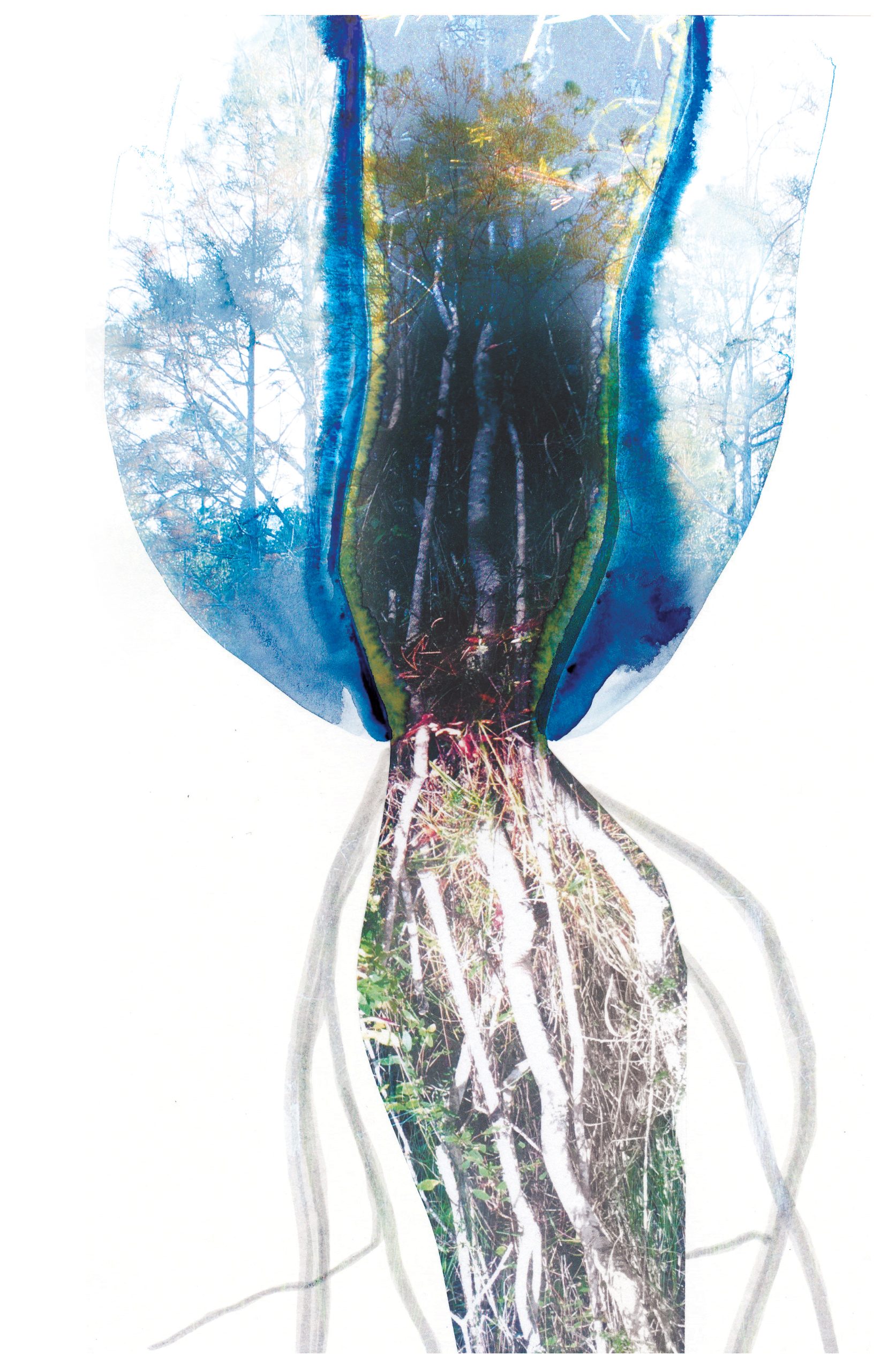
If there’s a theme that ties together my adventures in the wilds of the Florida Panhandle, it is my encounters with the creepy, the gross, the venomous, the blood-sucking, and the howling creatures that haunt this landscape. The Florida Panhandle is a lush oasis of white sand barrier islands and freshwater springs that gush up through bedrock to form swimmable pools of shimmering turquoise. In a photograph, the landscape appears to be a tame and relaxing paradise, but in reality, it is a very wild and sometimes threatening environment. I find being immersed in this risky utopia intoxicating—it makes me feel most alive. I go back to this place, where I am from, time and again because I am always surprised by a new encounter with something wild, unknown, or startlingly beautiful.
JUNE 20 | 2:30 AM
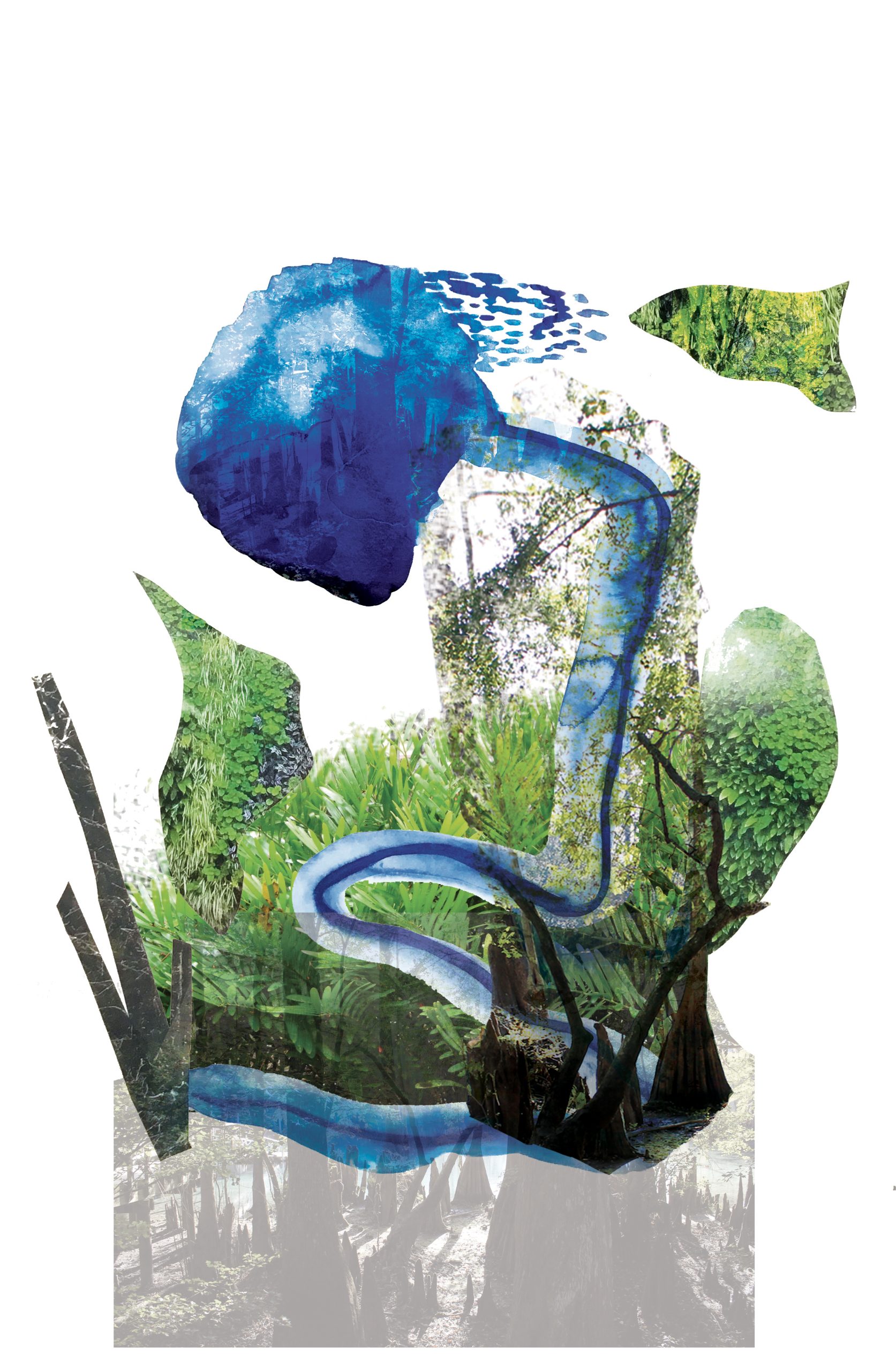
I am snuggly at home: a wild-looking woman in a wild landscape. I am awake, thinking about my presence in this sparsely populated part of the world, but the rain quiets my mind. I drift out of consciousness and into dreams about vines growing around my ankles while I am walking in the woods. Then the dream shifts to clouds rolling overhead and turkey vulture shadows chasing my footsteps. The growing-moving-cloud-vulture dreams quicken and then slow when they are interrupted by howling. I wake up again and take in a deep breath, unsure if the howling was part of my dream. I then hear a distinct growl followed by a snap of a mouth. An animal sound like a lip-smacking seems to come out of the darkness itself. Coyotes. Then, a long silent pause, during which I try to decide if I should stay put or run through the trees to the house. I wait. The sounds start up again farther away, I cannot tell how many, but there are several of them, and they start to howl back in a rotating chorus that seems to move downhill away from my tent. They howl off into the distance and fade into a dense thicket of woods. I sink back to sleep.
I am awake, sweating in a tent stationed on my family’s several acres of wooded property outside of Monticello, Florida. I had put the rain fly over the tent before crawling in earlier, and now rain is steadily pouring in thick massive drops. My skin is sticky all over from the humidity built up inside the tent. This area is densely humid in the summer months; people say the feeling of inescapable humidity is “like wearing a wet blanket.” But I like this feeling. It infuses my skin with gleaming moisture and triples my hair’s volume, causing it to curl up around my head defiantly.
JUNE 20 | 8:30 PM
The Florida Panhandle is wet—wet air, wet ground, wet plants. Waterloving creatures occupy all parts and vary from the mundane to the nasty. Some predictable ones include frogs, salamanders, crawdads, and whatnot. Then there are the nuisances of mosquitos and kissing water bugs. The more dramatic fauna include alligators and water moccasins.1 As a Florida kid, I learned that alligators feed only at specific times of the day—mostly at dawn and dusk—and common sense dictates that I steer clear of swampy water bodies during those times. Less predictable is the presence and temperament of water moccasins, the stealthy venomous snakes lurking in wetlands, swamps, streams, and all manner of wet prairies and marshes throughout the South. I have encountered them on many hikes, and I have always kept my distance by turning around and walking away if the snake is on its belly, slithering on the ground. If it is coiled in a ball, I walk in an arc around the snake to give a full buffer between me and the snake’s potential strike zone. I roam on, unfettered because snakes are shy; I show them respect by honoring their space.
On this wet-soaked, hot-air evening in June, I am walking with the owner of a neighboring property to get a glimpse of the spring-fed creek that runs through their part of the woods. It registers that I am walking downhill in the footsteps of the previous night’s coyote pack, toward the dense woods where they must have their dens. The neighbor confirms that the coyotes move through the area at night and then off into the thicker woods. I do not see coyotes or alligators as threats; they are easy to avoid. Water moccasins, on the other hand, are a threat. They blend in with their environment, and it is easy to step on one if you are not paying attention. Water moccasins are excellent swimmers; they swim with their bodies on top of the water. This behavior distinguishes them from non-venomous water snake look-alikes, which float with their heads popping above the water while keeping their bodies submerged. The water moccasin can be recognized by its elliptical slits for pupils and heat-sensing pits located between the eyes and nostrils. The cottonmouth, like other pit vipers, uses these heat-sensing pits to identify and accurately strike its prey. The heat given off by another animal creates a heat map of the victim when near the snake.
On this evening, with the sun going behind the trees, I step to the edge of the sandy-bottomed creek and into the field of vision of a cottonmouth that appears to be on the hunt as it swims against the current of the water. It is uninterested in my mass of heat and continues on its way upstream. I follow its wake in the water as it glides its fat body on top of the creek, muscles undulating in a contraflow to the stream. It disappears behind an elbow in the creek where the trees grow taller and drape in suffocating masses of vines and epiphytes. An impenetrable horde of spiky dwarf sabal palms covers the ground. Everything is still dripping with the previous day’s rain, and the air is so humid that water does not entirely evaporate; it just seems to hang in the air and envelop. Forests absorb moisture and expel it through their leaves as part of their oxygen-making process. Here, in the space above the creek before it continues into the woods, is a slight opening up to the sky, where a halo of misty light hovers above the stream. I turn my face up and breathe deeply to drown my insides with fresh wet air.
SEPTEMBER 15 | NOON
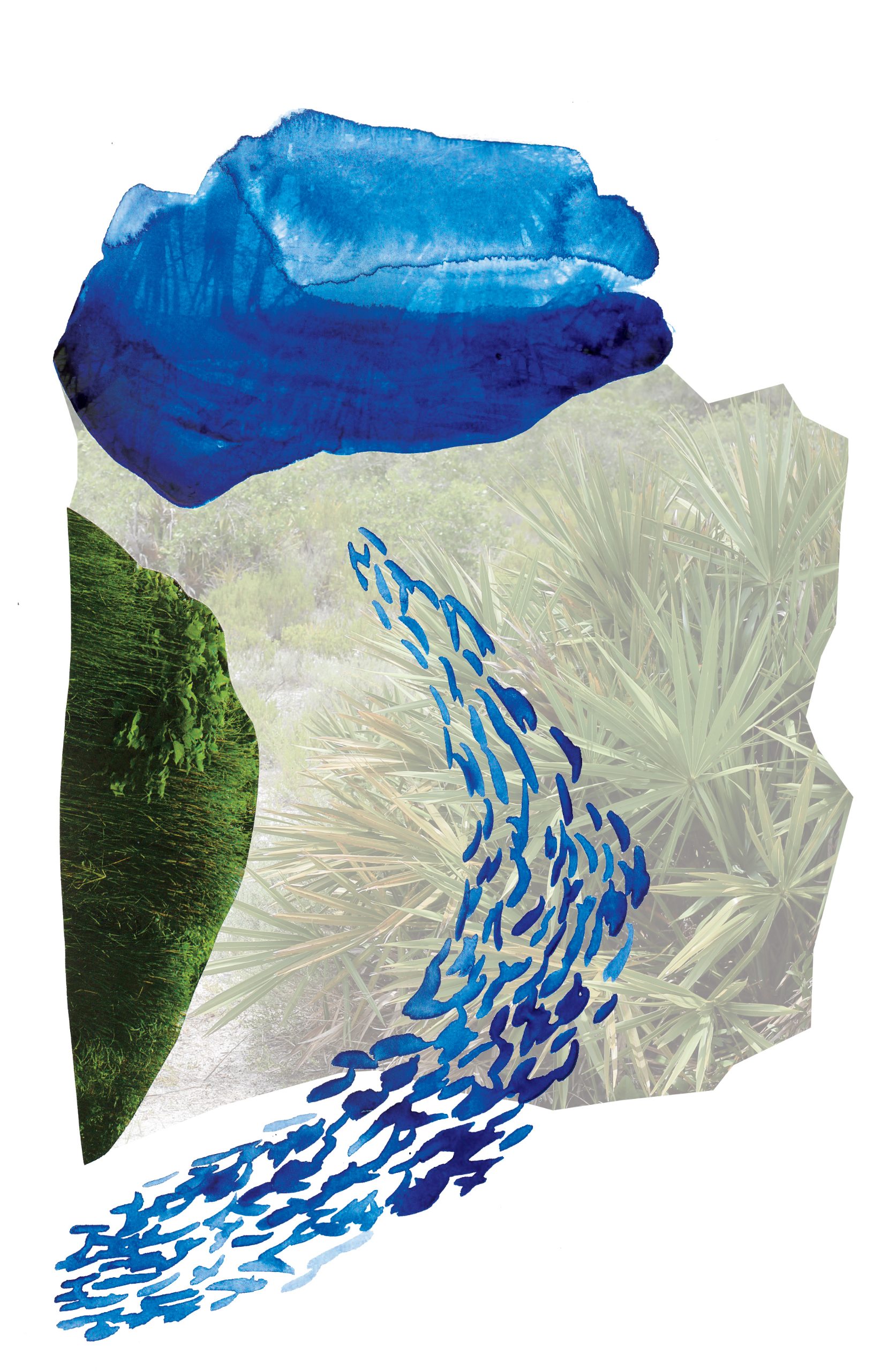
The ecological importance of the longleaf pine forest cannot be stressed enough. The thick sands are critical for aquifer recharge. The grass and wildflower understory are crucial for endangered species, from the gopher tortoise to the cockaded woodpeckers and even the Florida black bear. It is a unique type of forest, distinctive because of the rich ground layer and the filtered
Falling Waters, as the name implies, is a natural feature of trickling water falling off a cliff. It is a legitimate waterfall since it falls over an elevation difference of over one hundred feet. How is this possible in Florida’s flat terrain? It is a hidden waterfall, like an exposed cave, in the karst underlayer of longleaf pine forest in the Florida Panhandle. The soil of the Panhandle has a horizon that is unique from the rest of the state. The bedrock is karst; a Swiss cheese-textured brittle limestone that is highly dissolvable. Karst is a beautiful thing; it gives us sandy-bottomed creeks and white sand beaches and highly productive springs that spew water from deep inside the earth. On top of the karst sits a mantel of clayey well-sorted sands similar to the rest of the Coastal Plain of the southeastern United States. It is flat—or flattish—and at one time it was covered by an immense forest of pine trees. I am walking through Falling Waters State Park to find the actual water falling over a cliff, and cross through a remnant longleaf pine forest.
sun that support rare endemic wildflowers and pitcher plants. As an ecosystem that has been degraded and remains under constant threat, I am interested in knowing them as much for their ecological niche as for their phenomenology. I want to know how the longleaf pines sound. Could I recognize them based on sound alone? I know exactly how they smell, like piney woodsy sap mixed with the charred bark in the scars from recent controlled burn forest fires. I stop and listen to the pines and imagine that most of the Southeast United States once looked and felt like this. The trees are spaced far apart, without a dense understory typical of Appalachian or New England forests. What results is a thickened ground layer of wiregrass and wildflowers, with sunlight pouring through the eighty-foot trees. One of the best times to experience the longleaf pine forest is in the early morning, when fog is huddled at the base of the pines. The pines then look austere and old, as they cast long straight shadows with the morning sun coming in sideways, while the fog obscures the wild messy texture of the grasses. But I am here in the late afternoon, so I can only remember previously when I have been in this kind of woods at that time of the day.
The very structure of the plant communities—the size and spacing of shrub twigs—supports specific animals. The most straightforward example is the way birds occupy these zones: petite songbirds are in the ground and shrub layers; cardinals and jays in the understory; owls sleep in the live oaks, and then bald eagles and vultures nest in the towering pines. The temperature drop from the sunnier pine forest is immediately noticeable. I step down onto the boardwalk stairs into the cold, moist, dark forest and stumble onto the largest oakleaf hydrangea (Hydrangea quercifolia) I’ve ever seen. It is at least twelve feet tall and multi-stemmed. As my eyes adjust to the darkness, I recognize more species: water oak, loblolly bay, beauty berry, sweetbay magnolia, and a cascade of swamp maple leaves cloaking a dark space beyond the boardwalk.
I refocus on the present moment and watch an insect sew itself up in the wave-like leaf curl of its self-fashioned home. Tiny worlds are all around us, and the forest hosts multitudes of small worlds within worlds; they converse and collide with each other. I step as lightly as possible while thinking of the many ants foraging the ground for food. I walk on towards the boardwalk entrance into a dark and cool mass of broadleaf trees. Here, the forest changes and there is a more recognizable forest, flush with layered canopy, understory, shrub, and groundcover. Each of these layers is a sub-habitat within the subtropical hardwood forest.
I hear a steady stream of running water and continue towards it. Steps lead me down towards viewing decks for sinkholes—the sinks are where the bedrock has dissolved and caved in on itself. The story of Florida’s bedrock begins in the Jurassic period when the Florida peninsula was inundated with water. Most of Florida was an ocean floor where shells and marine animal skeletons accreted and compacted for 150 million years, forming what is now limestone bedrock throughout the state. This limestone is highly permeable and dissolves easily, creating a unique type of landscape called karst. Karst is a geomorphic form aided by the process of rock dissolution made possible by groundwater hydrology. Karst is “both an assemblage of landforms and a set of processes.”2 Florida’s particular bedrock is known as “drowned karst” because the aquifer drenched rock lies below sea level. The hydrogeology of karst is based on a massive network of cracks in the bedrock where water flows through the conduits. These cracks and openings are full of water. Falling Waters State Park is a prime example of karst, as landform and geologic process where the sinkholes have formed from the dissolution of the rock, creating a waterfall. More steps lead me down into a cavern of exposed karst bedrock, the sides thick with southern maidenhair fern. The water passes over a ledge that is above my head, and then it falls one hundred feet down where the water mysteriously re-enters the earth. No bubbling brook carries the water onward or downhill—it is like the bedrock opened a large mouth to swallow the water falling off the ledge. I get an unsettled feeling watching the water disappear. I stand inside of the rock’s gaping mouth with water visible only as it pours over the ledge, then falls into a vertigo-inducing distance in a single stream of water and disappears. Absorbed, not erased, but continuously sponged-up and folded into the ground. This moment embodies the magic and mystery of karst; how it operates as both source and sink of water. It is both sponge and faucet.
I pull off a paved county road and onto a dirt one. There is no person or car or house or airplane for many miles, and the absolute loneliness of this route is stark with old growth pine trees towering up, and casting their imposing shadows across the landscape. I am in Tate’s Hell Forest; a state protected area covering over 200,000 acres of land alongside the Apalachicola National Forest.
OCTOBER 21 | 10:30 AM
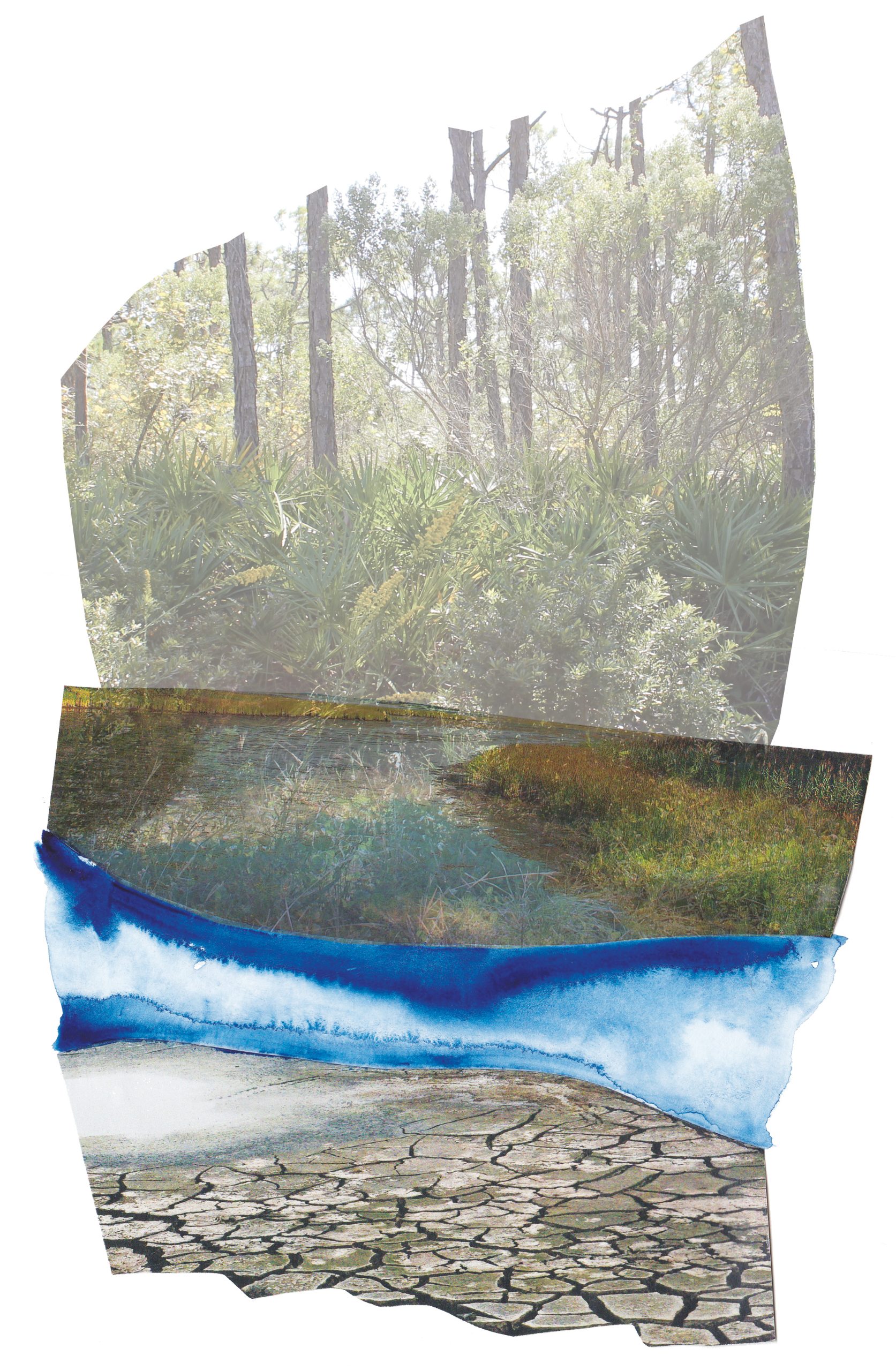
Tate’s Hell is home to the Florida black bear because here they have an uninterrupted and mostly unspoiled area to roam. Deep into the heart of Tate’s Hell lies an ancient swamp populated with dwarf cypress believed to be well over one hundred years old. This place is not a popular destination, not even among Florida hiking fanatics, because its remoteness and seasonally wet access roads make it very hard to reach. It can only be accessed through dusty streets a few months out of the year. To get to Tate’s Hell requires traveling on dirt farm roads for about ten miles off the state highway. These farm roads are strange in their linear regularity; they try to impose a logical geometry onto a cutthroat wilderness that creeps up and envelops you. This feeling of relentless fecundity and teeming wild impossibility is, in part, where it got its name. Over half of Tate’s Hell’s 200,000 acres are wet. The wet ground creates several ecosystem types: cypress swamp, wet prairie, and floodplain forest. Collectively, it sums up to a mind-boggling tract of land as difficult to traverse on foot as the more well-known expansive wetland to the south, the Everglades, which I have been fortunate to walk through as well. Tate’s Hell has a vast mosaic of swamp and swamp-like vegetation with wet areas fluctuating seasonally. The lines between inundated, a little wet, wet in places, or mostly dry are difficult to discern. At least in the Everglades, the wetland areas are punctuated by tree forests that rise out of the water and are recognizable at a distance. In Tate’s Hell, you cannot always see more than a few feet in front of you because there are places where the ground vegetation is so thick that it is impossible to see beyond.
I am traveling down a small raw farm road white with dust. The farm roads of Tate’s Hell are strange in their linear regularity as they cut through the woods at right angles to each other in an elongated grid. Seen in an aerial view, they create long rectangular blocks out of the woods. For this journey, I am alone in the car with my GPS directing me to the latitude and longitude
In Tate’s Hell, I begin to uncover the diversity in plant life occupying the mosaic of wet terrain. The forests of the Florida Panhandle contain one of the most ecologically diverse ecosystems in the world, because it holds a distinct niche at the climatological fault line between the subtropical and temperate zones. A shifting of exactly where these zones fall gives a glimpse to a climate change future. Soon, the more southern species of South Florida will begin to creep along the waterways of North Florida alongside the cypress trees. For now, Tate’s Hell exists as one dense tract of land within the biodiversity hotspot of the Florida Panhandle.
of the dwarf cypress area. I travel alone regularly and have come to rely on my gut feelings to make decisions. The GPS turns me onto a road made only of mowed grass and surrounded by swamp. I hesitate. The road is elevated above the surrounding swamp by a slim five inches. My instincts raise a small alarm asking, ARE YOU SURE ABOUT THIS? The way ahead looks clear, so I drive at a crawl, ready to stop if I encounter wet areas in the narrow grassy roadway. I proceed slowly and cautiously.
I am now clear of the wet ground and on my way back down the grass road. I am overcome with disappointment. I’ve experienced this feeling before when seeking out a specific place. Just a few days prior, I planned out a solo hike into a very remote part of the Florida Trail to see a maritime spring hidden deep in the St. Mark’s National Wildlife Refuge. A ring of cabbage palms, referred to as the Cathedral of Palms, fringes an untouched third magnitude spring called Shepherd Spring. I have read stories about the magical encounters of hikers along the St. Mark’s trail as they mucked through the fecund soil of a thick cabbage palm hammock and were then elated to find a pool so still and reflective that it looked to be made of glass. My attempt at the same experience was made impossible by rain so thick that I could hardly see to safely walk the trail. The rain came in heavy bands, as it likes to in this part of the world, and obscured the path. Getting lost in a heavy rain alone on a remote trail might make for a good story later, and I was already prepared to hike through a calfdeep swamp, but this would have made an already challenging hike just plain unpleasant. And so I didn’t go. Now I’m in the car, having maybe missed the best opportunity to see the dwarf cypress swamp, and wondering if this whole trip will be defined by a series of let-downs and missed opportunities. I decide to exit left via a side
The latitude-longitude coordinates are less than a mile away, and I feel a sharp pull in my stomach marking my excitement for what’s ahead. It is a kind of hunger of anticipation for the first glimpse of something new and special. Just as I feel giddy, anxiously watching for the early signs of the dwarf cypress, I sense the front tires become heavy and laden with wet sand. Anxiety sets in as I feel the tires lose traction. I am halfway into a wet depression in the road. It is unclear how deep the water is or exactly where it ends. This time my gut says, STOP. TIME TO TURN AROUND. I listen to my intuition and manage a very tedious and anxiety-filled process of inching back and forth, putting the car in reverse and then forward, reverse and then forward, again and again, in a hilarious 12-point-turn to move the car around on a narrow strip of grass flanked by water.
road to go deeper into the forest, since I know that I will make it back to one of the state roads that cuts a line through the woods. Besides, going deeper into the woods opens up more opportunities for encounters with the who-knowswhat-could-happen. I push on into Tate’s Hell—it is a lucky choice. Not two miles beyond where I turned, I spot a small dusty sign reading “Dwarf Cypress boardwalk .5 miles.” Feeling optimistic, I turn and amble down a much higher and well-maintained farm road. I reach a cleared area with another small sign declaring “Dwarf Cypress Forest.” I get out and walk to the boardwalk that begins at the edge of the swamp. The swamp starts with tupelo trees rising out of a wet blackness and then closing in on themselves in a dark, mysterious forest, before opening up to deeper water with dwarf cypress trees. The cypress, Taxodium distichum, is a common tree throughout the South. But here, the cypress has the most bizarrely formed trunks. Some of them have cartoon proportions with a broad base that tapers up just ten feet into an apex of short-pointed branches. Others have more typical branching structures that reach like curved arms horizontally away from the trunk. Each tree is a sculpture 150 years in the making and reminiscent of Dr. Seuss’ drawings—he must have come here, if only in his dreams when imagining the settings for his books.
The boardwalk rises above the dwarf cypress for a view out into the entire swamp. From this perspective, the gradient from wet to dry is visible in the tree line. The canopy texture changes from pine needles to tupelo leaves to cypress needles, in tandem with the moisture level in the ground, as it goes from dry to sometimes wet to mostly wet. The tupelo have started to turn fire red, and the cypress is beginning its autumn blush into blazing orange. The light hitting them at a low angle in October saturates their glow as if on fire. The trees rise out of the water, with the water surface as bright and reflective as a mirror. The water mirror creates a perfect slice between two realities, like an architectural section cut between a submerged world below and an oxygen-filled world above. The trunks, real and reflected, meet at the mirror plane and reach away from each other, ending in glowing embers of orange and red.